
Rotator Cuff Injury: Symptoms, Causes, and Treatment Options

Have you ever felt night pain in your shoulder and wondered if a small tear could be the cause?
I am Dr. Lokesh Chowdary R (MBBS, MS – Orthopaedics), Managing Director and Senior Orthopedic Surgeon at Boss Multispeciality Hospital, Magadi Main Road, Bangalore. In my hospital near Kamakshipalya and RR Nagar, I see many people with shoulder problems and similar questions.
I will briefly explain what a rotator cuff problem is and why the signs can be confusing. Pain, weakness, and limited movement do not always match the size of a tear.
This article is a practical how-to guide. You will learn how to spot early warning signs, what causes these issues, when to seek specialist care, and how I choose treatment.
I favour careful history, a focused exam, and imaging only when it changes management. Many cases improve with planned nonsurgical care and physiotherapy; surgery is reserved for clear medical need.
Recovery varies by tear size, tissue quality, and daily demands. Book an appointment for a proper evaluation so we can make an individualized plan together.
When I Suspect a Rotator Cuff Problem in the Clinic
When someone tells me their shoulder wakes them at night, I pay close attention right away. That story often points to a treatable problem that affects daily life and sleep.
I hear the same patient story often: pain that stops sleep, trouble dressing, difficulty combing hair, reaching into a back pocket, or lifting light items during normal activities. Night pain is common because lying on the side increases pressure on irritated tissues and makes pain more noticeable.
I begin to suspect a true tendon problem when a person reports pain with overhead motion, pain reaching behind, and noticeable weakness that limits function. Early evaluation matters because repeated painful use over time can make small tears larger.
- Stop painful overhead lifting and avoid provocative motions today.
- Plan an orthopedic assessment rather than self-diagnosing.
- Most painful shoulders respond to careful therapy; not all need surgery.
| Concern | Likely cause | Immediate action |
|---|---|---|
| Night pain | Irritated tendon or bursa | Change sleep position, avoid pressure |
| Weakness with lift | Partial tear or tendon strain | Stop provoking tasks, get exam |
| Persistent pain after days | Possible enlarging tear | Arrange early imaging and review |
Understanding the Rotator Cuff and the Shoulder Joint
I explain the shoulder as a ball set in a shallow socket. This joint trades deep bone fit for soft-tissue control, so muscles and tendons do most of the stabilising work.
The four muscles and where they attach
The rotator cuff includes supraspinatus, infraspinatus, teres minor and subscapularis. Their tendons attach to the upper arm bone and hold the ball centered in the socket.
How the cuff supports lifting and rotation
These four muscles coordinate lifting, rotation, and overhead motion. Small changes in mechanics can shift load to a tender area and create pain during certain activities.
The bursa and extra irritation
A bursa is a small sac that reduces friction between tendon and bone. If it becomes inflamed, it can cause a sharp pinch with some motions and make daily tasks harder.
Why physiotherapy helps
Rehab focuses on control, strength and range motion to reduce tendon stress. Improving posture and muscle balance often eases pain and restores function without surgery.
| Structure | Main role | Rehab focus |
|---|---|---|
| Supraspinatus | Starts arm lift | Scapular control and gentle strengthening |
| Infraspinatus & Teres minor | External rotation | Rotational endurance and scapular stability |
| Subscapularis | Internal rotation | Balanced internal rotator strength |
| Bursa / subacromial space | Friction reduction; can irritate near bone spurs | Reduce compression, improve mechanics |
Rotator cuff injury symptoms I Want You to Watch For
Not all shoulder problems are loud; some start as a nagging ache or a sudden loss of strength. Below I list clear signs to help you decide when to seek review.
Deep aching shoulder pain, especially at night
A dull, deep pain that wakes you or worsens when lying on the affected side is common. Night pain often means irritated tendon or bursa and disrupts sleep.
Difficulty lifting or reaching behind
If you struggle to lift your arm overhead, reach a shelf, or fasten clothing, note the loss of range and when it began.
Weakness and the feeling the arm may “give out”
Weakness on rotation or lifting can occur even with little pain. A sense the arm may drop or fail with load is an important red flag.
Clicking or popping with motion
Clicking or popping often comes from irritated tissue moving in a tight space. It may be harmless, but get checked if it causes pain or limits motion.
Stiffness, tenderness, mild swelling
Gradual stiffness and mild swelling can be subtle but persistent. If day-to-day tasks stay harder for more than a few weeks, arrange an exam.
- Observe which movements trigger pain and whether sleep is affected.
- Note if weakness or loss of range is worsening over days or weeks.
| Sign | Likely meaning | What to do |
|---|---|---|
| Night pain | Irritated tendon or bursa | Change position, seek early review |
| Weakness | Functional loss despite low pain | Clinical exam and imaging if persistent |
| Clicking | Irritation or tight space | Assess mechanics; physio or review |
Types of Rotator Cuff Injuries and What They Mean for Treatment
Different problems in the shoulder need different plans, so I first identify which tissue is affected. That decision guides whether I recommend rest and physiotherapy or consider surgical review.
Tendinitis (overuse)
Repetitive overhead work, sports, or certain jobs often cause tendon inflammation. It feels like a nagging ache with motion and usually responds to activity change and guided rehab.
Bursitis (compression and inflammation)
A bursa can become inflamed when it is repeatedly pressed between tendon and bone. This causes sharp pain with lifting and needs anti-inflammatory measures and physiotherapy.
Impingement (space matters)
When the subacromial space narrows during motion, the tendon and bursa get pinched. Fixing mechanics and posture can relieve irritation without surgery for many patients.
Partial versus complete tears
Partial tears are fraying or thinning of tendon tissue. They often improve functionally with non-surgical care.
Complete tears mean a full detachment. These may cause clear weakness and sometimes need surgical repair, depending on age, demand, and tear size.
| Type | Typical sign | Usual plan |
|---|---|---|
| Tendinitis | Overuse pain | Rest, physio, activity change |
| Bursitis / Impingement | Pain with lift | Reduce compression, rehab, injections if needed |
| Partial / Complete tears | Weakness or loss of function | Start non-surgical care; surgical review if persistent |
- I favour non-surgical treatment first when possible.
- Surgery is discussed when a tear causes persistent weakness or fails conservative care.
Common Causes and Risk Factors Behind Rotator Cuff Tears
Shoulder tears often start slowly, or after a single fall, and knowing the cause helps me advise the right care.
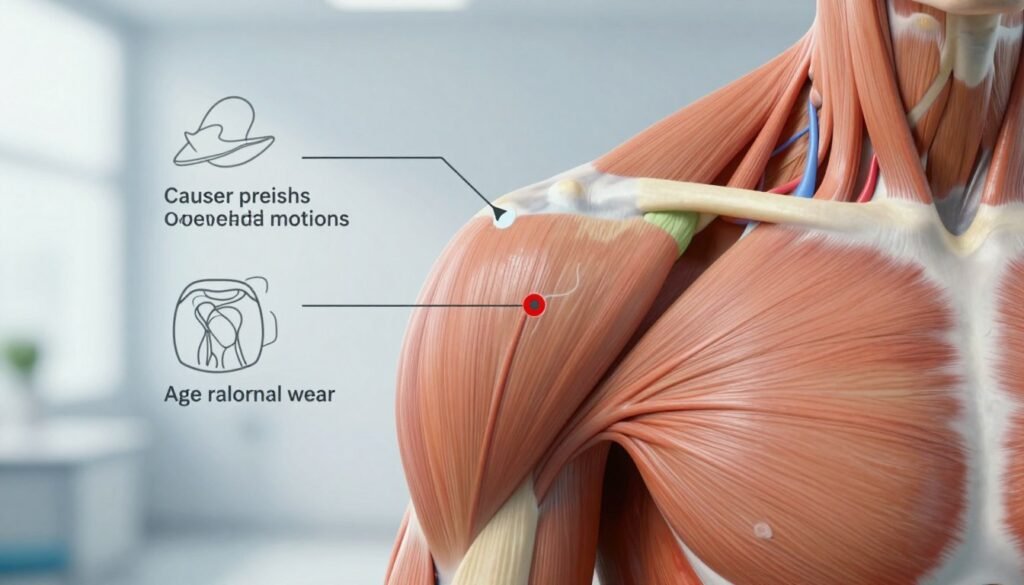
I classify causes as sudden or degenerative. Acute causes include falls, collisions, or a sudden heavy strain that overloads a tendon. These events can create a clear tear needing prompt assessment.
Degenerative wear usually appears after about age 40. Reduced blood flow to tendons with time makes tissue weaker and slower to heal. Over years, small fraying can become a larger tear.
Repetitive overhead work and sports raise risk. Tennis, swimming, and heavy lifting stress tendons when form, rest, or flexibility are poor. Bone spurs may also rub on tendons and cause gradual damage.
Poor posture narrows the shoulder space and increases tendon compression. Health factors — diabetes, smoking, thyroid problems, and high cholesterol — reduce tendon quality and slow recovery.
Prevention is practical: correct posture, smart training with rest, avoid repetitive overhead load, and seek early review if pain or weakness starts.
| Cause | Typical patient story | How tendons are affected | Practical prevention |
|---|---|---|---|
| Acute trauma | Fall or sudden strain | Immediate tendon tear or overload | Early exam; immobilize briefly; targeted rehab |
| Age-related degeneration | Gradual loss of strength after 40 | Thinning due to poorer blood supply | Strength work, activity modification, regular checks |
| Repetitive sports/overhead work | Persistent pain with tennis or lifting | Microtears from repeated load | Technique coaching, rest, cross-training |
| Bone spurs & health risks | Longstanding ache, worse with overhead | Mechanical rubbing; poor tendon healing | Correct posture, manage diabetes, stop smoking |
When You Should See an Orthopedic Specialist for Shoulder Pain
If daily tasks become harder because of weakness or sharp pain, it is time for a specialist review.
Red flags that need prompt attention include a sudden inability to lift the arm, severe pain after a fall, or pain that repeatedly wakes you at night.
Short periods of rest and activity modification are reasonable at first. If symptoms persist beyond a few days despite rest, seek assessment. Ongoing painful use can enlarge partial tears over time and make recovery longer.
Before your visit, note when the pain began, which movements trigger it, and whether weakness is getting worse. This helps me form a focused plan quickly.
I will reassure you that early evaluation rarely means immediate surgery. Most visits lead to a clearer treatment path: targeted exercises, selective imaging, or a staged plan to restore function safely.
| Warning sign | Likely meaning | Immediate action | Clinic next step |
|---|---|---|---|
| Sudden loss of lifting | Significant tear or severe strain | Arrange urgent review | Clinical exam, possible imaging |
| Severe pain after fall | Acute injury needing assessment | Limit movement; see specialist | X‑ray and focused scan if needed |
| Persistent night pain | Ongoing tendon or bursa irritation | Modify sleep position; seek review | Physio plan, consider imaging |
| Symptoms > few days | Risk of worsening tear | Stop provoking activities; get seen | Stepwise care: rehab first, then review |
If you are nearby, I invite you to Boss Multispeciality Hospital for a focused assessment and a clear plan tailored to your needs.
How I Diagnose Rotator Cuff Injuries at Boss Multispeciality Hospital
Accurate diagnosis starts with a clear history and a focused clinic exam at Boss Multispeciality Hospital on Magadi Main Road, Bangalore, near Kamakshipalya and RR Nagar.
I begin with active and passive range motion checks. I compare movement and strength side‑to‑side. Short, targeted tests help me separate true weakness from painful guarding.
Plain X‑rays are next when I suspect bone problems. They show spurs, joint alignment, and other bone issues that change treatment choices.
When I need to confirm a tendon problem or measure a tear, I choose MRI or ultrasound. These scans help plan rehab or consider repair. Ultrasound is quick and cost‑effective. MRI gives detailed soft tissue maps.
For complex or unclear cases, I may use arthroscopy. This lets me inspect the joint directly and combine diagnosis with minimally invasive repair if needed.
I aim for clarity: match the clinical picture to imaging so we pick the least invasive, effective plan for your shoulder.
| Step | What it shows | When I use it |
|---|---|---|
| Clinical exam | Range, strength, pain pattern | First visit for focused assessment |
| X‑ray | Bone spurs, alignment | Suspected bone cause or prior trauma |
| MRI / Ultrasound | Tendon quality, tear size | Plan repair or detailed rehab |
| Arthroscopy | Direct inspection; treat if needed | Complex cases or concurrent repair |
How-To Manage Rotator Cuff Pain Without Surgery
A stepwise plan focused on protection, guided therapy, and patience often reduces shoulder pain and restores use.
Rest and activity modification
Start with short periods of rest to prevent repeated tendon irritation. Avoid painful overhead motion but keep gentle active movement to prevent stiffness.
Ice, heat and medicines
Use ice after activity and heat before gentle exercise. Anti-inflammatory medicines can help pain for a short time; take them under medical advice.
Physiotherapy-guided recovery
I place early emphasis on restoring range motion first, then safe strengthening and task-specific exercises under physical therapy. This staged therapy lowers load and rebuilds control.
- Protect the tendon, not complete immobilisation.
- Progress strength slowly; return to work or sport by function, not by time alone.
Outcomes, injections and timelines
Tears do not reliably heal without surgery, but about 8 in 10 people with partial tears improve functionally with non-surgical treatment. A corticosteroid injection may be used to control inflammation so you can engage in therapy more comfortably.
| Step | Goal | Typical time |
|---|---|---|
| Protective rest | Reduce pain | Days–weeks |
| Therapy | Range motion then strength | Months |
| Return to function | Sustain load safely | Up to a year |
When Surgery Is Medically Needed and What Recovery Looks Like
Deciding on surgery is a careful balance between the tear, your function, and how well non‑surgical care has worked. I consider surgery when there is a complete detachment, clear loss of strength, or when conservative treatment fails to restore use.
Arthroscopic repair and what I do
Most repairs are arthroscopic through small incisions. I use a camera and fine instruments to remove bone spurs if needed and reattach the tendon back to bone.
Debridement for partial tears
For fraying partial tears, trimming rough tissue can reduce pain and catching. This may be enough without full repair in selected cases.
When a tear isn’t repairable
Chronic, large tears sometimes cannot be reattached. In those cases I discuss alternatives such as tendon transfer, bridging procedures, or symptom‑focused surgery to improve function.
Early recovery and timelines
Expect a sling for about four to six weeks, then staged physical therapy. Many patients regain useful strength in four to six months, with full recovery often taking 12 to 18 months.
| Step | Goal | Typical time |
|---|---|---|
| Sling protection | Protect repair | 4–6 months initial protection then rehab start |
| Active rehab | Restore motion | Weeks to months |
| Strength return | Functional arm use | 4–6 months; full recovery up to 18 months |
Recovery varies with tear size, tissue quality, and your daily demands. Follow precautions, attend therapy, and tell me early if progress stalls so we can adjust the plan.
Conclusion
Early action — not alarm — is the best way to protect your shoulder and preserve everyday function.
The rotator cuff is key to stable shoulder movement. Common signs include night pain, trouble lifting overhead, and noticeable weakness that limits activities.
Many cuff problems improve with physiotherapy, activity changes, and time when managed early. Some tears cause little pain yet still reduce strength, so persistent loss of function needs evaluation.
Treatment and recovery are individual. Age, tissue quality, health factors, and daily demands shape the plan I recommend.
If you live near Bangalore, book an appointment with me, Dr. Lokesh Chowdary R, at Boss Multispeciality Hospital on Magadi Main Road (near Kamakshipalya and RR Nagar) for a focused assessment and a step‑by‑step recovery plan.